Can Old Controls Be Upgraded Without Downtime?
A PLC that still runs the line is not necessarily a PLC that can support the next five years of production. When operators are relying on obsolete processors, unsupported HMIs, failing drives, or a control panel with no usable drawings, the question becomes: can old controls be upgraded without creating more risk than the system already carries?
In many cases, yes. Legacy controls can often be modernized in phases while retaining sound field devices, mechanical equipment, and portions of the existing electrical infrastructure. But an upgrade is not a simple hardware swap. The feasibility depends on the condition of the machine, the availability of documentation, the communications architecture, safety requirements, and how much downtime the operation can tolerate.
Can Old Controls Be Upgraded? Usually, but Not as a Direct Swap
A controls retrofit can range from replacing an obsolete HMI to rebuilding an entire control system around a modern PLC, distributed I/O, new drives, updated safety hardware, and SCADA connectivity. The right scope is determined by operational risk, not by the age of one component alone.
For example, an Allen-Bradley SLC 500 system may still control a conveyor line reliably, but processor availability, aging I/O modules, limited communications, and scarce programming support can make a planned migration to CompactLogix or ControlLogix worthwhile. A Siemens S5 installation may require conversion to an S7 platform because replacement hardware and engineering tools are no longer practical. In other cases, the PLC is serviceable, while the operator interface, network, or safety circuit is the real weakness.
The goal is not to replace equipment for its own sake. The goal is to remove single points of failure, improve diagnostics, maintain safe operation, and give maintenance teams a system they can support.
Start With an Assessment of What Still Has Value
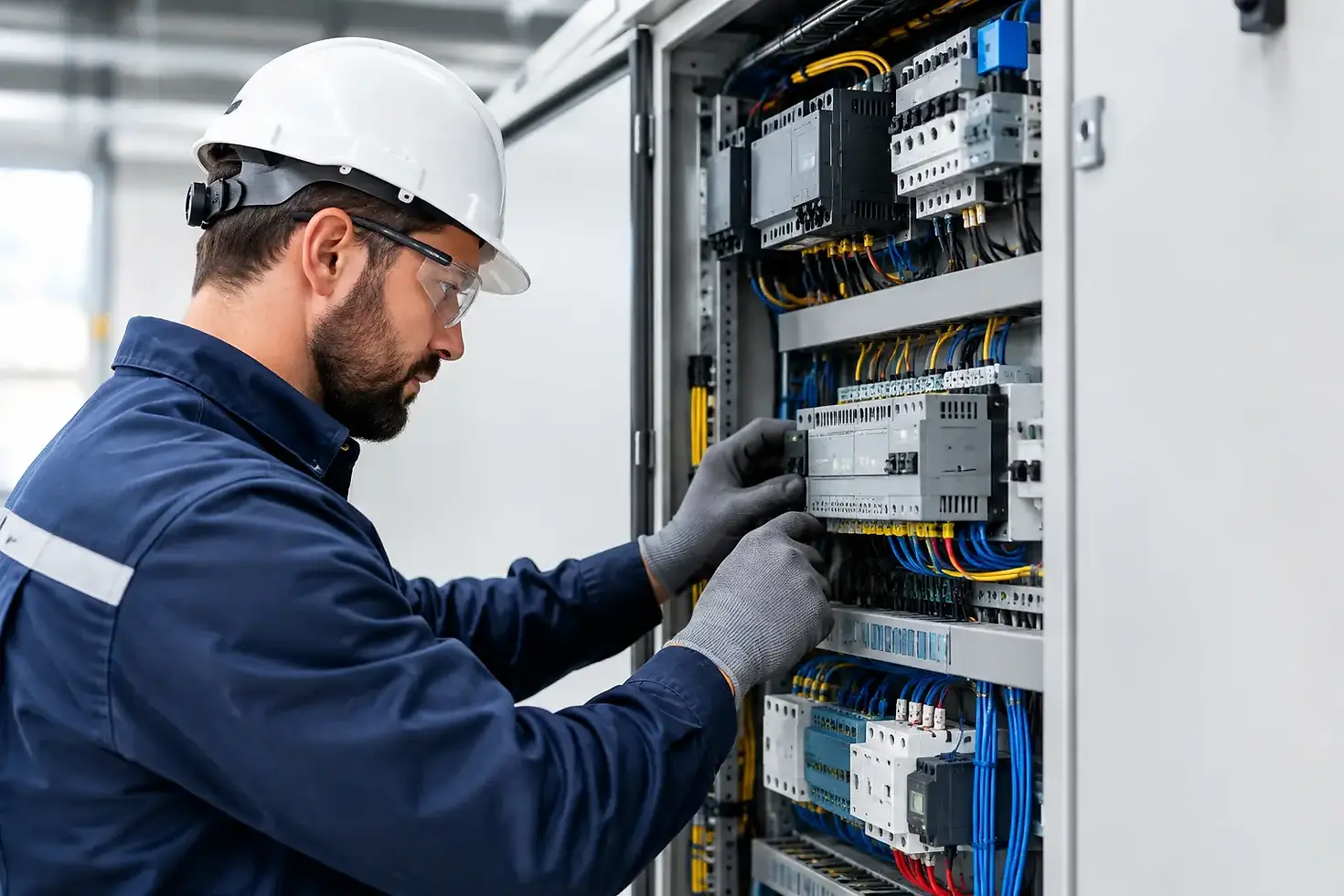
A good modernization project begins in the field. Engineers need to inspect the panels, trace critical circuits, review code, verify I/O, and understand how the equipment behaves during startup, normal production, faults, and emergency stops.
Existing motors, sensors, valves, cylinders, power distribution, and even remote I/O can sometimes remain in service. If a 24 VDC sensor network is in good condition and properly documented, it may not need replacement when the controller is upgraded. If older analog instruments are stable and calibrated, they may be retained with appropriate signal conditioning or new analog input modules.
What commonly drives replacement is not simply age. It is poor reliability, lack of replacement parts, inadequate capacity, unsafe design, unsupported communications, or a lack of documentation that makes troubleshooting too slow and too risky.
A practical assessment should answer several operational questions:
Which failures would stop production immediately?
Which components have no realistic replacement path?
Are electrical drawings and PLC backups accurate?
Can maintenance personnel diagnose faults without a specialist?
Does the current system meet the required functional safety level?
Will new equipment need to communicate with the existing controls?
Those answers establish whether a targeted retrofit, phased modernization, or full controls replacement is the soundest option.
What Can Often Be Retained During a Controls Retrofit
Modernization does not automatically mean replacing every device connected to the panel. Reusing suitable equipment can control cost and reduce shutdown duration, provided compatibility and safety are verified.
Field wiring can often be retained if it is labeled, tested, appropriately sized, and in acceptable condition. Motors and motor starters may remain in place when their duty, protection, and reliability are acceptable. Existing VFDs may also be retained if they have supported communications and can be integrated with the new PLC. For simpler applications, a new controller can operate existing starters and discrete devices through replacement I/O.
Mechanical systems should also be evaluated separately from the controls system. A new PLC will not correct worn conveyor bearings, inconsistent pneumatic pressure, poorly adjusted photoeyes, or undersized motors. Modern controls can make these issues easier to detect, but they cannot eliminate a mechanical reliability problem.
The same applies to legacy software. Some program logic can be converted or reused as a reference, but older code often contains workarounds added over years of troubleshooting. Recreating that logic line by line can preserve hidden faults. In many projects, the better approach is to document the intended machine sequence, build clean code around it, and validate operation during commissioning.
The Hard Parts Are Usually Integration and Safety
The most difficult portion of a legacy upgrade is frequently what sits outside the PLC rack. Production equipment may include old serial devices, proprietary drive networks, barcode systems, weigh scales, printers, vision equipment, building systems, or vendor-installed machinery with limited documentation.
A modern controller may communicate through EtherNet/IP, Profinet, EtherCAT, Modbus TCP, or OPC UA, while legacy devices may use serial protocols, DeviceNet, Profibus, or hardwired signals. Gateways can help in some situations, but they add another component to maintain. It may be more reliable to replace a critical legacy device than to build the project around an aging communication converter.
Functional safety requires its own evaluation. Emergency stops, guard switches, light curtains, safety relays, and safety PLCs must be reviewed based on the actual hazards and required risk reduction. An upgrade that improves production control but leaves undocumented or inadequate safety circuits in place can create a larger operational problem.
Safety changes should be engineered, validated, and documented. This is particularly important for conveyors, packaging equipment, robotics, amusement systems, and any machinery where unexpected motion or delayed stopping creates exposure for personnel.
Plan Downtime as an Engineering Task
The best retrofit projects reduce outage risk long before the installation date. A plant should not discover missing signals, reversed motor rotation, or undocumented interlocks during the only scheduled shutdown of the year.
Where practical, the new control panel can be built and tested off site. PLC and HMI software can be developed from verified drawings, I/O lists, and a documented sequence of operations. Simulated I/O, bench testing, and factory acceptance testing help identify software problems before the equipment is disconnected.
During installation, a staged cutover may be possible. One conveyor zone, machine cell, process skid, or panel can be upgraded at a time while adjacent equipment remains operational. This is often effective in distribution centers, bakeries, and manufacturing lines with bypass routes or redundant equipment.
A full cutover may still be necessary when the system has tightly coupled safety circuits, shared networks, or a single controller managing the entire operation. In that case, success depends on a detailed outage plan, labeled wiring, verified backups, spare components, clear rollback criteria, and the right technical resources available during startup.
Signs That a Full Replacement Is the Better Choice
A partial upgrade is not always the lower-risk choice. Full replacement is often justified when the existing system has widespread wiring deterioration, multiple obsolete platforms, unsupported safety equipment, undocumented modifications, repeated nuisance faults, or no dependable source for spare parts.
It can also be the better long-term decision when the operation needs capabilities the legacy architecture cannot reasonably provide. Common examples include production reporting, remote diagnostics, recipe management, historian integration, alarm notification, cybersecurity improvements, or connection to a warehouse management system.
A mixed system may keep production running in the short term, but it can leave maintenance supporting several software packages, programming cables, processor families, and spare-parts inventories. That complexity has a real cost during a 2 a.m. failure.
Choose the Upgrade Scope Based on Operational Risk
The right answer is rarely “replace everything” or “change only the failed part.” A critical line with no redundancy may justify a complete, planned modernization before a catastrophic failure forces an emergency shutdown. A stable auxiliary machine with readily available spares may only need an HMI refresh and documented backups.
For each system, weigh the cost of the project against the cost of unplanned downtime, lost throughput, overtime, safety exposure, and long troubleshooting events. A controls integrator should be able to translate those risks into a practical scope, not push a platform or a larger project than the operation needs.
Modernization works best when it is treated as reliability work. Build a current backup, capture accurate drawings, identify weak components, define a tested sequence of operation, and schedule the work before the obsolete part dictates the schedule. That approach gives the operation control of the outage instead of waiting for the outage to take control of the operation.


Comments